Friday, July 16, 2010

Boost your Guitar Hero skills 101 - SLEEP! Really?

We have been told that feeling well-rested while studying and reviewing your work just before bedtime enhances your memory for what you have studied. But when it comes to the role of sleep in motor memory, the answer is less clear. A recent research abstract presented at the 24th annual meeting of the Associated Professional Sleep Societies LLC by Dr Kevin Peters from Trent University suggests that sleep enhances our performance in complex motor learning tasks, as measured by an larger increase in accuracy levels obtained in playing guitar hero in the sleep condition compared to the wake condition.

However, an earlier paper by Cai & Rickard (2009) suggests that after controlling for circadian (time of day) and homeostatic (time since sleep) confounds, participants in the sleep conditions did not display any benefits in a motor sequence task.

The participants in their research were categorized into 3 conditions - a wake group, a 1 night sleep post-training group and a 2 night sleep post-training group. Participants were tasked to tap a number sequence, 4-1-3-2-4 repeatedly and reaction times (RTs) were measured. All participants trained at about 9.30am and were tested on 5.30pm on the day itself or on Day 2 and Day 3 depending on which conditions they were in.

Comparing difference scores of their RTs for the 3 different groups revealed no significant differences between them. If sleeping does indeed improve motor memory, we would expect a significant reduction in RTs for the sleep groups compared to the wake group. Therefore, it appears that after controlling for circadian and homeostatic factors, sleeping after training does not improve motor sequence performance.


Unfortunately, I do not have access to the exact methodology and results of Peter's study to verify if the concerns about the relevant confounds raised by Cai & Rickard (2009) are adequately addressed. Therefore, as far as I'm concerned, the jury is still out on the specific benefits (if any) conferred to motor memory by sleep. But I must say that Peter's design holds much promise (he certainly won't have any trouble finding willing and good subjects).

Well, regardless of whether sleeping helps you perfect that golf swing or ramp up your skill level on guitar hero, it’s still a good idea to get a good night's rest to ward off the negative effects associated with sleep deprivation in other domains of our lives. Afterall, according to a study by Falleti, Maruff, Collie, Darby & McStephen (2003), driving after being awake for 24hrs is like driving with a blood alcohol concentration of 0.05%. Not quite enough to get you arrested but probably more than enough to make you think twice about pulling that all-nighter.


ResearchBlogging.org
Cai, D., & Rickard, T. (2009). Reconsidering the role of sleep for motor memory. Behavioral Neuroscience, 123 (6), 1153-1157 DOI: 10.1037/a0017672

Falleti MG, Maruff P, Collie A, Darby DG, & McStephen M (2003). Qualitative similarities in cognitive impairment associated with 24 h of sustained wakefulness and a blood alcohol concentration of 0.05%. Journal of sleep research, 12 (4), 265-74 PMID: 14633237

Wednesday, July 7, 2010

Is Money the Arbitrator of the Fine Line Between Self-Interest and Community Spirit?

Does money serve as a great incentive and motivator or does it serve to undermine relationships? At the heart of the debate for society, this is akin to the perennial capitalism vis-à-vis communism conflict. And perhaps the truth is that they are both right.

Vohs, Mead & Goode's (2006) nine experimental studies, which culminated into an illuminating piece of work titled The Psychological Consequences of Money, found that both characteristics of money - a great incentive or an underminer of relationships - emerge from the same underlying process: money makes people feel self-sufficient and therefore behave accordingly.

In Experiment 1, participants were assigned randomly to three conditions. In two conditions, participants were reminded of money (Play Money and Money Prime) while in the control condition, participants were not reminded of money. In each condition, participants were instructed to unscramble jumbled up words to form sensible sentences, and therein lay the prime. In the Money Prime condition, the scrambled text contained concepts of money. In the Play Money and Control conditions, the scrambled texts were neutral, but participants in the Play Money condition were exposed to Monopoly money in their peripheral visual field.

Next, participants were given a challenging but solvable problem to work on. As the experimenter left the room, he offered that he was able to provide assistance if the participant wanted. How long the participants persisted before asking for help became the dependent variable to be measured.

It was observed that participants who were reminded of money (both Play Money and Money Prime) worked on the problem longer than control participants before requesting for help. The difference between the two money conditions (Play Money vs Money Prime) was insignificant.


Experiment 2 was a modification of Experiment 1 such that the constructs being measured were an abundance of money (High Money) against restricted amount of money (Low Money). Participants then had to read aloud an essay in front of a video camera. The video camera was used in place of an experimenter so as to remove the potential confound that might result from status differences between the experimenter and the student.

Participants in the High Money condition read about growing up with abundant financial resources, while participants in the Low Money condition read about growing up with meagre financial resources. Participants were then, like in Experiment 1, unknowingly tested on how long they would take to solve an unsolvable puzzle before requesting help.

Once more, participants in the High Money condition worked significantly longer than participants in the Low Money condition before asking for help. This experiment also confirmed that the effects of money did not depend on relative status differences between the participant and the experimenter/helper.


Given the findings thus far and the overall hypothesis, the authors predicted that people who value self-sufficiency would be less helpful than others because they will tend to expect others to be self-sufficient as well. The authors do not elaborate on this aspect, but a few reasons why this is a reasonable stipulation include:

  • the tendency for people to project their own personalities onto others in order to form more efficient judgments and anticipate behaviours of others,

  • the fact that schemas associated with ourselves are more accessible and thus more easily activated, and

  • the possibility that we have evolved psychological mechanisms to assume that when we are rich, the environment allows for it because we are in a resource-rich area, and we are more likely to be dealing with other rich people residing in our local environment.

Thus, in Experiments 3, 4 and 6 (all involving different sets of randomly selected subjects), the authors sought to test whether participants primed with money would be less helpful relative to control participants.

Using the word descrambling methodology from Experiment 1 to manipulate the priming for both money and neutral conditions, the DV - willingness to provide assistance - was then measured. Experiment 3 tested participants on their tendency to help out in a future task (willingness to help code the data sheets of the current experiment), while Experiment 4 tested their helpfulness on an immediate helping situation (willingness to help a fellow 'latecomer' participant, who was really a confederate, figure out the experiment's instructions). Experiment 6 assessed how willing participants were in donating their participation payment to a university student fund.

It was found that participants in the money condition volunteered to help code fewer data sheets (Experiment 3), spent half as much time providing help to the latecomer on the instructions (Experiment 4) and donated less money (Experiment 6) than participants in the control condition.

In Experiment 5, participants were made to play Monopoly with a confederate. After a few rounds, the game was cleared except for differing amounts of play money. Participants in the High Money condition were left with $4000 (participants will be aware that this is a large sum of Monopoly money having been sensitized to the game), while participants in the Low Money condition were left with $200. Control condition participants were left with no money. For High Money and Low Money participants, the money was kept in conscious sight for the second step of the experiment. At this step, High Money participants were asked to imagine a wealthy future while Low Money participants were asked to imagine a financially insecure future. Control participants were asked to imagine their plans for the next day.

This was followed by a staged accident where a new confederate, who was both blind to the condition the participants were in and carrying a lot of things, walks across the laboratory and drops his pencils (27 in total) in front of the participant. The number of pencils picked up by the participant became the measure of helpfulness.

Participants in the High Money condition helped gather significantly fewer pencils than participants in the Low Money and Control conditions. Helpfulness did not differ between the Low Money group and the Control group.

To ascertain self-sufficiency as the construct that is really being tested, the final three experiments tested the effects of money on social intimacy, desire to engage in leisure activities alone and preference to work alone.

In Experiment 7 involving screensavers, participants were randomly assigned to either the Money condition, Fish condition or No Screensaver condition. All participants were made to fill in questionnaires while sitting in front of an idle computer screen. After a few minutes, one of three screensaver types would appear - one depicting various denominations of currency floating underwater, one with fishes swimming underwater, and one with just a blank screen.

After some degree of exposure to the screensaver, participants were told they would get acquainted with another participant in the same experiment, but the experimenter would require some assistance to arrange the chairs for the session. Participants primed with the Money screensaver placed the two chairs for him or herself and the potential acquaintant farther apart compared to participants in both the Fish group and the No Screensaver group.

Participants primed with money appeared to place more social distance between themselves and others.

Experiment 8 tested whether money-primed participants would prefer being alone even when choosing leisure activities that are potentially of a social nature. The priming manipulation was similar to Experiment 7, except that instead of screensavers being used, participants were now facing posters. The Money condition participants faced a poster showing various denominations of currency, while the two control groups faced a poster showing either a seascape or a flower garden.

Participants were next given a nine-item questionnaire that asked them to choose between two leisure activities per question. Within each item, one option was an experience only one person could enjoy while the other option was for two or more people. Money-primed participants chose more individually-focused leisure activities than participants from the control groups.

Money primes thus appear to lead people to become less social.

Experiment 9 provided a more rigorous test of the self-sufficiency hypothesis by directly assessing social preferences. Participants were put through the screensaver primes from Experiment 7 before being asked whether they preferred to work alone or with others. Once more, participants desired to work less with a peer when exposed to money primes.

The nine experiments provide support for the proposed argument that money activates psychological mechanisms that bring about a state of self-sufficiency. It might even appear somewhat surprising that such minor tweaks in environmental and social conditions towards a heightened sensation of financial resources might induce a person to be more independent and socially insensitive.

As the authors sum up well, "The self-sufficient pattern helps explain why people view money as both the greatest good and evil. As countries and cultures developed, money may have allowed people to acquire goods and services that enabled the pursuit of cherished goals, which in turn diminished reliance on friends and family. In this way, money enhanced individualism but diminished communal motivations, an effect that is still apparent in people’s responses to money today."

So ultimately, perhaps whether you believe money is inherently good or evil might begin with what inclinations you have towards social dynamics and morals to begin with.

ResearchBlogging.org
Vohs, K., Mead, N., & Goode, M. (2006). The Psychological Consequences of Money Science, 314 (5802), 1154-1156 DOI: 10.1126/science.1132491

Tuesday, June 29, 2010

Link between Sexual Motivation State and Dopamine Release in the mPOA?

Is an increase in dopamine release in the medial preoptic area (mPOA) specifically related to male physical arousal and sexual behavior or does it have a bigger role in sexual motivation?

Kleitz-Nelson, Dominguez, Cornil & Ball (2010) investigated this question by using the Japanese quail (Coturnix japonica). The male quail does not an have an intromittent organ and therefore does not require an erection to successfully copulate. The researchers collected and measured the dopamine content from extracellular samples from the adult male quails’ mPOA every six minutes before, during and after exposure to a female quail.

What they found was that for male quails that copulated, their levels of extracellular dopamine increased dramatically past baseline levels (BL1-3) when the female quail was introduced (F1-F6) and decreased after the female quail was removed (POST1-POST6). Non-copulators did not exhibit an increase in extracellular dopamine levels.


In addition, for copulators, the researchers did not find any changes in extracellular dopamine levels between sampling periods during which the quails either engaged in the actual mating behavior or not. That is to say, during the sampling period, regardless of whether the male quail was engaging in coitus or not, their levels of extracellular dopamine levels showed increased levels as long as they are in the presence of the female.

The authors thus concluded that the rise in extracellular dopamine in the mPOA is not only involved in erection and ejaculation, as the copulators had high levels of extracellular dopamine regardless of whether they were actually engaging in mating behavior at that moment. And given that the quails do not require an erection for copulation to occur, the evidence suggests strongly that extracellular dopamine in the mPOA is specifically associated with sexual motivation and not just physical arousal.

ResearchBlogging.org
Kleitz-Nelson, H., Dominguez, J., Cornil, C., & Ball, G. (2010). Is sexual motivational state linked to dopamine release in the medial preoptic area? Behavioral Neuroscience, 124 (2), 300-304 DOI: 10.1037/a0018767

Saturday, June 19, 2010

"Can't Touch This" - The neurophysiology of pleasant touch


Touch is crucially important for social communication, mediating how we perceive and interpret the actions of others. For example, waitresses who touch customers get better tips (Crusco & Wetzel, 1984). However, touch alone does not always lead to positive outcomes. For many years researchers have known that touch is moderated by factors such as type of touch, location of touch, situational context, and many others. Until recently however, they were uncertain as to how the social effect of touch was achieved. In this review by Olausson et al., the authors shed light on how pleasant and socially relevant aspects of touch are possibly mediated by a new distinct type of receptors called C-Tactile afferents.

To give a little background, human touch is generally considered to be mediated by 3 different type of receptors:
  1. Thermal Receptors allow us to feel warmth and heat.
  2. Mechanoreceptors allow us to feel pressure.
  3. Nociceptors allow us to feel pain from chemical or heat damage.
For the most part, the mechanoreceptors are myelinated afferents. "Myelinated" means that the part of the neuron that transmits the signals are covered with an electrical insulator that allows it to conduct impulses at high speed (50m/s). Myelination is essential for quick reaction. "Afferent" neurons are neurons which carry information towards the central nervous system.

In the early part of the 20th century, mechanoreceptors that were unmyelinated were identified in various mammals like cats. They were termed C tactile (CT) afferents. For a time it was thought that humans did not share this primitive and slower tactile system, which conducted impulses at a speed of 1m/s. However in the 1990s they were soon found in abundance in hairy skin around the arms and legs, but not on the hairless surface of the palm.

The only appropriate time to use a lolcat.

Immediate testing of the sensitivity of these CT afferents found that they were for lack of a better word, wierd. They could not discriminate between pin pricks and smooth probe pressure, but however responded best to a slow stroking with a soft brush.

Direct evidence for the specific role of CT afferents was however, hard to achieve, because it was not possible to stimulate CT afferents without also activating myelinated afferents in normal subjects. The authors studied subjects who suffered from sensory neuronopathy, a condition where subjects lacked myelinated afferents but have intact C fibres. These subjects were long thought to have lost all tactile sensations but they detected soft brush stroking. Much of the CT effect was however, below conscious level. They could not effectively locate where the touch was delivered, and were not able to describe it, only saying that it was slightly to moderately pleasant.

FMRI imaging of the neuronopathy subjects also found that the posterior insula cortex was activated, but not traditional somatosensory systems identified with other tactile stimulation. This region is considered important for integrating converging information and passing it on to emotional systems. For one thing, it has been shown to be involved in the perception of pain.

Based on the evidence, the authors believe that CT system is involved in social touch. For one, the poor conduction velocity and poor discriminative properties of CT afferents make them ill-suited for processing the complex features of touch, features which are easily handled by other mechanoreceptors that are myelinated. Why then would they be present in humans? For another, the CT system appears to be tuned to slow, light touch, which occurs most often during close interactions with loved ones. The evidence from the sensory neuronopathy patients appears to confirm this fact.


So, what does this tell us? For the scientist, this research opens up new areas of research into the biological foundations of the social and emotional aspects of touch, which has longed focused purely on physical sensations. For the layman, not much. Intuitively we already reach out to stroke someone who is upset when we have no idea how to comfort that person, even if we do not know whether it would help. This review, and the research that has been done, confirms that physiologically, there is an effect. So, keep touching (as long as its appropriate, of course) :)

Ed's note: For another noteworthy study which was not mentioned in this review, but which I'm guessing was done by a postgraduate student of the author, you can refer to http://www.sciencedaily.com/releases/2009/04/090414084453.htm.

ResearchBlogging.org
Olausson, H., Wessberg, J., Morrison, I., McGlone, F., & Vallbo, �. (2010). The neurophysiology of unmyelinated tactile afferents Neuroscience & Biobehavioral Reviews, 34 (2), 185-191 DOI: 10.1016/j.neubiorev.2008.09.011

Wednesday, June 16, 2010

Is your best friend’s relationship advice/decision really the best for you?

When you have a relationship decision to make and you are at a loss as to which is your best available option, are your friends the ones you turn to? If your answer is yes, the following article may make you think twice in the future.

In the article Risk-Taking in Relationships: Difference in deciding for Oneself Versus for a Friend, the authors explored the idea that people tend to make riskier decisions or give riskier advice for their friends as opposed to when they are making one for themselves. Most existing research has so far focused on people making decisions for themselves. However, there is a lack of empirical research on decision making for others, which is a rather common situation in life. Examples include doctors making decisions for patients or politicians for their constituents. The authors decided that decision making in relationships would be a good starting point as participants are undergraduates, often with a good chance of encountering such relationship choices.

The first experiment asked 201 participants to fill in a questionnaire of 11 scenarios concerning real-life relationship problems. There were two options for each scenario, one that was risk-averse (e.g. a fun time with friends) and another that was risk-taking (e.g. potentially having a fun time with an attractive member of the opposite sex). All participants were grouped into 3 categories: (1) deciding for themselves, (2) deciding for a same-sex friend, and (3) advising a same sex friend. A risk-averse option receives a score of 0 and the alternative gets a score of 1. Therefore, if a participant chose the risk-taking option for all 11 situations, the score would be 11.

The results indicated that participants made riskier choices for their friends as opposed to for themselves. Moreover, results showed that there were no differences for the other-decision group and the other-advice group. However, a life impact analysis of the scenarios reveals that the impact of the situation on the person’s future life could influence the self-other difference. Therefore the second experiment was conducted to investigate this possibility.

In the second experiment, 20 scenarios were pre-rated with 12 chosen. Six of them were of the highest score for low life-impact and vice versa for the high impact scenarios. In general, the results concurred with the first experiment and the possibility of self-other difference from low or high impact scenarios was also confirmed. Participants were more risk-taking in low impact scenarios and more risk-averse in high impact scenarios. However, a non-linear analysis suggested that the conclusion might not be as straightforward. Evidence from the non-linear analysis indicated that not every low-impact scenario had participants choosing a more risk-taking decision for their friend. Self-other difference was non-existent or reversed in three of the six low-impact scenarios. For example, when asked if they would give their phone number to someone they just met at a party, 80% said they would but only 67% said they would tell their friend to do the same thing. Experiment 3 sought to find out why people take more risk in some scenarios when it comes to deciding for a friend while other scenarios produce a completely different set of results.

Before discussing Experiment 3 proper, a brief review of some literature to provide rational explanations will prove useful. People in general take into account more information when deciding for oneself than for others. One way to interpret this is that positive consequences are accounted for in oneself and others but people will also focus on the negative consequences only when deciding for themselves. The corollary is that there is a bias towards riskier decisions for one's friend since positive consequences weigh more in the decision-making process. Insofar as this explanation is true, we can reasonably expect self-other differences to disappear for high-impact scenarios, but what about the three low impact ones previously mentioned?

Each scenario (giving out a phone number, going to an out-of-town concert and buying a gold chain for a significant other) has the potential to produce negative outcomes. For example, going out of town for a concert may be dangerous if you find yourself too far from home with a person you've just met. As a consequence, there might be a chance that such considerations are not completely ignored despite the scenario being generally of a low impact.

There are generally two mechanisms by which negative information can be directed when making decisions. The first states that such information is not even brought to mind when deciding for others. If this is the case, explicitly stating the negative consequence would serve to negate the self-other difference. The second possibility is that the consequences, albeit being brought to mind, are given less weight.

Experiment 3 tested both versions. For this experiment, each scenario was provided with both positive and negative consequences for each risk option (same questionnaire as Experiment 2) for one group and no such consequential information for another group. If this inclusion eliminates the self-other difference, the first mechanism is supported. In addition, the conclusion of this experiment asked participants to provide reasons for their choices in the three low-impact scenarios with the largest self-other differences as in Experiment 2. If participants stated more negative reasons, it would mean they were aware but chose to ignore the consequences.

Results of Experiment 3 indicated that, regardless whether consequential information is present, the self-other difference is not removed for the low-impact scenarios. For the open-ended questions at the end, participants gave more negative reasons when deciding for themselves than for others. This raises an interesting question because it contradicts the prospect theory where people in general place more importance on losses than on gains. Maybe we place a different emphasis on our decisions when it comes to deciding for others.

With these results in mind, we definitely do know that people take more risks for their friends in decisions, at least with respect to relationships. So, before the next time you go banging on your friend’s door regarding your relationship problems, do bear in mind what their decision could mean to you.

ResearchBlogging.org
Beisswanger, A., Stone, E., Hupp, J., & Allgaier, L. (2003). Risk Taking in Relationships: Differences in Deciding for Oneself Versus for a Friend Basic and Applied Social Psychology, 25 (2), 121-135 DOI: 10.1207/S15324834BASP2502_3

Monday, June 14, 2010

Sorry honey, I just had to buy that dress! - When cognitive overload undermines our self-regulatory ability.

Counterintuitively, people who exercise self control in some way, such as dieting or trying not to look at or think about something, might end up buying things more impulsively instead if given the opportunity.

Vohs & Faber (2007) explain in their study, Spent Resources: Self-Regulatory Resource Availability Affects Impulse Buying, that opportunities for impulse purchasing have increased with the proliferation of ATMs, shopping on the Internet, and shop-at-home television programs. Depletion of cognitive self-regulatory resources coupled with ever-increasing avenues for impulse buying might just be the answer.

In one experiment, 35 undergraduate participants were made to watch a video of a woman talking on the pretext that they were going to judge her personality later. To suppress one group's attentional resources, irrelevant words were flashed at the bottom of the screen and participants were told to ignore the irrelevant words and focus instead on the woman. Another group was given no such instruction to divert their attention away from the words, and thus served as the control group. After the video, participants were told that they were taking part in a marketing study to determine the prices that students would pay for various products.

It was found that participants who had their attention manipulated assigned significantly higher prices to the products than participants in the control group.

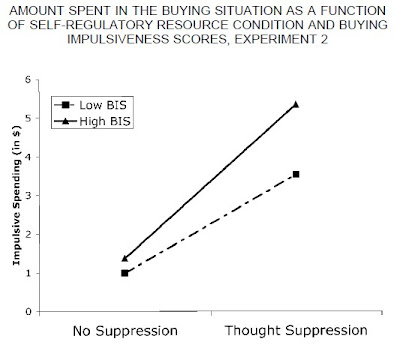
In the second experiment, 73 undergraduates participated by first completing the trait Buying Impulsiveness Scale (BIS), a scale developed by Rook and Fisher (1995) which measures generalized urges to spend impulsively. This was followed by a thought suppression exercise where participants were induced with the thought of a 'white bear', an interesting experimental technique developed by Wegner in 1989 that has been proven to drain considerable cognitive resources. Participants were told to write down their thoughts for the next few minutes. Participants in the Thought Suppression condition were told that they should try and avoid thinking of a white bear and if they did think of a white bear, they should place a check mark on their paper and then resume recording their thoughts. Participants in the No Suppression condition could think of anything they wanted, including white bears.

After this, participants were told that they were going to be involved in a study about introducing new products at the university bookstore. Participants would be given $10 for their participation in the study, after which they could either leave with the money, or they could make a purchase with the items that were available as part of the bookstore's product study.

It was found that spontaneous buying behaviour is once more predicted by mental resource depletion, as students who did not have to suppress their thoughts were more likely to keep the $10 and leave. Additionally, an interaction effect between dispositional buying impulsiveness (as determined by the BIS) and the self-regulatory resource condition was found. As the authors assert, "Among people who are prone to buying impulsively, temporary lapses in self-control ability signal a strong possibility that impulsive, unplanned, and perhaps unwanted spending may occur."


In the last experiment of the study, 40 undergraduate subjects took a variant of the second experiment to determine that the results were not confounded by other cognitive or affective traits, such as the desirability of the items being purchased.

This study extends the research on impulse buying, which has come a long way since the 1980s where people were simply labeled as either impulsive or nonimpulsive purchasers, effectively indicating that there is an interaction between both dispositional and environmental influences that determines impulse-buying. In other words, personality and social factors both play a part. The authors conclude: "Self-regulatory resource availability would be an important element in determining when and why people engage in impulsive spending." Without enough self-regulatory resources, people will be less able to overcome urges and substitute desirable behaviours with undesired ones. Thus, temporary reductions in the capacity to self-regulate leads to stronger impulsive buying tendencies.

From this research, it appears that people in modern contexts do not stand confidently in the ability to control their temptations, as contemporary city-living inundates our senses with a twin barrage of cognitive overload as well as opportunities to spend.

ResearchBlogging.org
Vohs, K., & Faber, R. (2007). Spent Resources: Self‐Regulatory Resource Availability Affects Impulse Buying Journal of Consumer Research, 33 (4), 537-547 DOI: 10.1086/510228

Friday, June 4, 2010

Sorry, what's your name again? - How stress impairs our social memory.

Ever felt that someone hasn't been paying attention to what you were saying in previous conversations because he/she forgets biographic information about you that you had mentioned countless times? Well, it turns out that it might just be that they're stressed out by something else.

In their paper, Stress Impairs Retrieval of Socially Relevant Information, Merz, Wolf & Hennig (2010) investigated the hypothesis that parts of our social memory (memory about names, birth dates, parts of other people’s life) fail because of stress.

15 women and 14 men were recruited to take part in an experiment whereby they were randomized into either the Stress or Control conditions. All participants started the experiment by memorizing two biographical notes (one from each gender) which includes photos, home towns and parts of their life stories.

Stress was then induced on the participants in the stress condition by instructing them that they would have to give a public speech 10 minutes later. Cortisol levels in saliva samples collected during 5 different time intervals during the whole experiment were used to quantify their stress levels.

All participants were then tested on the biographical notes that they learnt at the beginning of the experiment. Participants were tested on recognition (selecting the correct answer out of 5 choices), correction (marking the incorrect answer out of 5 choices) and reproduction (answering semi-open ended questions). Global Memory indicates the average of the three tests.

The authors found that participants in the stress condition had significantly lower recognition, reproduction and global memory scores than participants in the control condition.


Mean cortisol response during memory retrieval of responders (participants who show stress induced cortisol increase) also had a significant negative correlation with the recognition task and global memory score.

The authors conclude that acute stress reduces our ability to retrieve socially relevant information and that there was an association between these stress-induced retrieval deficiencies and cortisol response to the stressor.


So, cut that person some slack when he/she forgets something about you; it might just be the cortisol, or even the pressure you're inducing on the person to remember stuff about you!

ResearchBlogging.org
Merz, C., Wolf, O., & Hennig, J. (2010). Stress impairs retrieval of socially relevant information. Behavioral Neuroscience, 124 (2), 288-293 DOI: 10.1037/a0018942